
Below is the full text of a LIT blog post from 02/19/2026.
–
I arrive at this conclusion with my eyes open: it is morally wrong to withhold carefully tested AI tools from unrepresented litigants when the alternative is ChatGPT or nothing at all.
Late one night, some say, Robert Johnson waited for the devil at a Mississippi crossroads. In exchange for his soul, he became the greatest Blues guitarist of all time.
Embedded in this Faustian narrative is a self-denying suspicion: we got rock and roll, but such a great reward must have come at a terrible price. Are some legal aid attorneys taking the same mental shortcut with AI?
While nonprofit law firms are early adopters of large language models (which I will call just “AI”), many have concerns. A split in opinion on whether AI is safe and ethical was obvious at the most recent Legal Services Corporation’s Innovations in Technology Conference.
I have been in the trenches: from the early days of decentralized online media, to the frontlines of eviction defense at Greater Boston Legal Services, to publishing research in AI and law before ChatGPT, and finally delivering traditional guided interviews in both HotDocs and Docassemble for the last decade. I hope my perspective has value.
I do not believe that using AI means accepting second-class justice for poor people. When done right, it means expanding the pie by giving litigants more choices for how, when, and where they get their legal help, putting their needs first.
This essay walks you through my thinking on both the positive case for AI and why I reject the most common criticisms.
How to evaluate your AI use case: the “crossroads” test
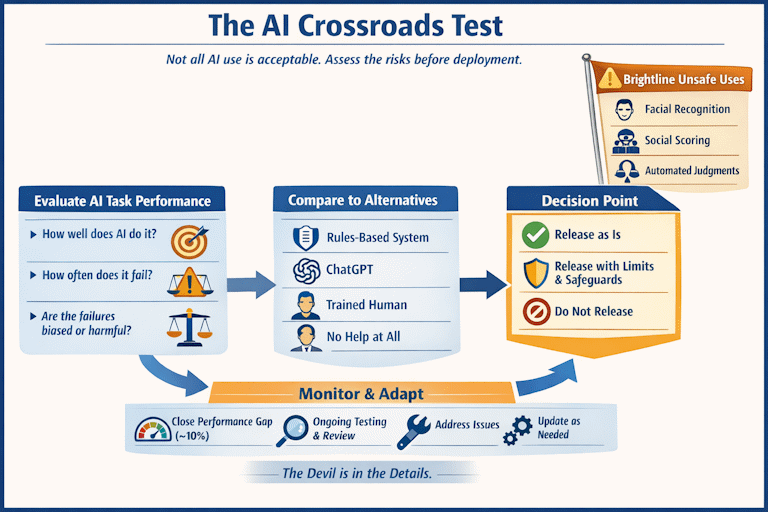
Not all AI use is acceptable. For example, the European Union’s AI Act (Annex III and Article 5) lists several prohibited tasks for AI, ranging from facial ID to making decisions about employment and guilt or innocence.
Beyond these brightline cases, the key is to have a realistic idea about:
- Given a task for AI:
- how well can AI do it,
- how often it fails, and
- whether failures are unfairly distributed, biased, or harmful.
- And then comparing that performance quality to:
- a rules-based system,
- ChatGPT,
- a trained human,
- or no help at all.
After weighing the two values, decide if the tool:
- can be released as-is
- is impossible to release safely
- can be released with a more limited scope, cautions, or guardrails
If the tool meets a real need, is better than ChatGPT, performs close “enough” to a human, and passes the safety and bias tests, it’s worth releasing. I aim to get to a gap of no more than 10% between the AI and human performance on most tasks, recognizing that humans also vary in performance.
Releasing is not the end of the story. Ongoing monitoring is critical to see if your tool survives an encounter with the real world. There are many testing and monitoring strategies that you can follow for your project, and many were on display at the most recent ITC.
Call this analysis the “crossroads” test. And, of course, the devil is always in the details.
Since I first published this essay, Dave Guarino of Propel wrote an amazing distillation of these tradeoffs. It builds on many of the themes in this essay but is worth its own read.
The positive case for using AI
AI tools can solve real-world problems for poor people today

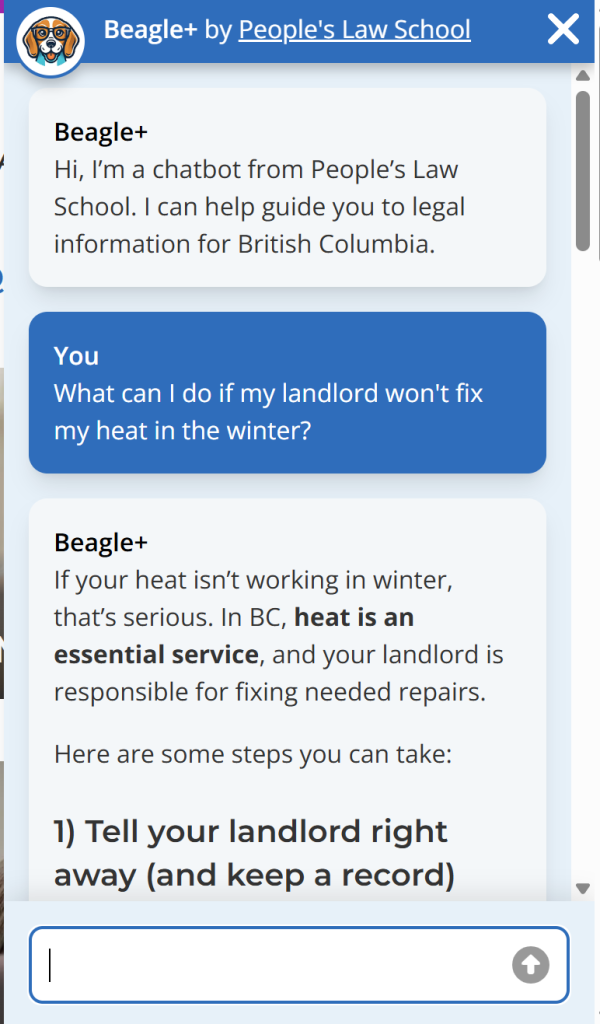

Over the last twelve months, we’ve seen many new AI tools launch. From academic studies to production legal aid products, they are solving problems that are hard to imagine solving without AI’s help.
- RAG solutions, like Beagle+ in British Columbia, Legal Aid of North Carolina’s Lia, and New York City’s Roxanne tenant help tool, turn natural language questions into a tailored response from a trusted knowledgebase.
- Legal intake, triage, and referral solutions like an AI self-triage tool for Missouri Tenant Help, the FETCH classifier for Oregon State Bar, and Lemma’s WorkflowDocs, use AI to match applicants to legal help resources or provide basic case facts to their attorney.
- Voice tools are being adopted to reach low smartphone penetration areas by legal aid programs like Virginia Legal Aid Society and in the African country of Niger.
- Los Angeles Superior Court is using AI to catch invalid defaults, and in Lancaster County, Pennsylvania, the American Arbitration Association is helping stop bad debt collection cases before they are filed.
Stanford has gathered many more examples of AI projects and use cases.
AI may solve problems for litigants in ways that they prefer

From saving litigants time to making tools that are more natural, dynamic, and accessible, AI has the promise to improve the experience of unrepresented litigants.
Poverty in America means going to many certification appointments, filing endless paperwork, and traveling long distances with public transit to reach an aid office. DIY tools built with AI give litigants ownership of their time: they can file an eviction answer at 12:30 AM when they are off their shift, the children are asleep, and their mind is racing.
A Nature study showed that AI has a better bedside manner than a human doctor. AI can be an active and empathetic listener, cutting down on repetitive questions and remembering to mirror the litigant, especially compared to rigid document automation systems.
Finally, AI can improve access across low English-language literacy, access in other languages, and to those with disabilities. Machine translation now approaches the quality of human translation in many domains, although it still requires human review. And AI agents already add alternative text to images, detect contrast issues, and help web applications reach WCAG accessibility standards.
AI assistance can accelerate the work of legal aid attorneys and free them up for impactful work
So-called agentic AI helps our Lab update contact information for court locations and perform other tedious administrative tasks. When we built CourtFormsOnline in 2020, we used rules alone to speed up the task of building guided interviews. We now incorporate generative AI, leading to a dramatic speed increase. Applied to general law practice, agentic AI gives attorneys back time to shine, allowing human traits like empathy, trust, and negotiation to get more focus.
The roads in front of us lead to ChatGPT or safer help
There is strong demand for the current versions of ChatGPT to solve litigant’s ordinary legal problems. I have heard this repeatedly from practitioners, clerks, and judges.
Even when someone hires an attorney, today they are likely to use ChatGPT as a second opinion or to explain a confusing advice letter.
At this crossroads, we have not two choices, but three:
- Try to prevent ChatGPT from giving legal help, through lobbying to add guardrails, or an education campaign for litigants.
- Refuse AI altogether, and avoid giving AI any stamp of approval, even if we recognize that some litigants will use it anyway.
- Apply a “harm reduction” approach, which might include training for litigants or launching safer alternatives to unfiltered ChatGPT, even if they do not reach perfection.
Zoe Dolan, an attorney in Los Angeles, ran a multi-week training program for appellate litigants with a framework she calls TACT: think, act, challenge, test. The litigants learned how to use ChatGPT safely to help research and draft their appeals, with some amazing wins.
Approaches like Zoe’s show that it is not all or nothing. I believe in harm reduction as the right road to take, and I do so clear-eyed but optimistic about the potential benefits.
Understanding the objections to AI
If there is a devil at this crossroads, it hides in the details. The question is not whether potential harms exist: it is whether they outweigh the cost of doing nothing.
Concerns about how AI functions
AI is not human, and at best allows us to reach an uncanny valley, removing humanity from interactions
The “uncanny valley” is a theory that the closer something gets to seeming human without being fully human, the more it makes humans uneasy or uncomfortable. Design choices, like using AI-authored forms instead of open-ended chat, can help. Even so: sometimes we all should be able to talk to a person.
AI has embedded biases
Because of embedded biases, AI should not be used as a tool for making decisions, especially when name, gender, race, or proxies for those terms might be accidentally revealed, as shown in multiple examples from hiring to parenting time disputes.
This bias may also cause uneven failure rates across different groups in otherwise safer tasks. When error rates are low but unfairly distributed, a legal aid program should consider changing the scope or withdrawing a tool.
AI is random and therefore unreliable, and it cannot truly “think”
Despite AI’s randomness, we can test it enough to know how often it succeeds and how often it fails. We rely on statistics all the time to make decisions about safety. Some failures, like hallucinated case citations, can be partially mitigated.
Yet, AI can be surprisingly alien, as Ethan Mollick points out when he describes AI’s jagged frontier and viral tests repeatedly show. We cannot rely on human analogy to know when AI will work at a new task. We need to do both testing and ongoing monitoring for each use case.
Concerns about the political and long-term consequences
AI is controlled by rich companies who will centralize control and “rent seek” by increasing prices beyond their current affordable rates
AI models are approaching commodity status, like basic web hosting, and at our scale the low end is good enough. This makes “enshittification” a distant concern. Even if the quality and price gap increases between the free and frontier models, we can use today’s free-to-the-world AI forever, via open-weight models like DeepSeek, GPT-oss, and Llama, to help a lot of people.
AI will displace human labor
AI will replace many current lawyer tasks. But I do not think it will ever fully replace lawyers. AI today is best at self-contained tasks, like so-called “legal products” already solve. Increased efficiency may even lead to expanded employment.
In legal aid, we only serve 10% of the eligible population experiencing a legal need, leaving room for vast efficiency improvements without justifying job cuts. If legislatures use AI as a cover for funding cuts to legal aid, we should rightly raise hell.
Creating AI products confers unwarranted legitimacy on them and risks reputational harm
Warnings and disclaimers help, but do not erase the risk that litigants will trust our tools more than the same product from ChatGPT. This tells us that equaling the quality of ChatGPT is not enough for most uses.
Concerns about the ethical implications
Some ethical concerns are unsettled, but it’s not clear that anti-AI positions will win in the long run.
On the environment, evidence shows that AI can save energy compared to performing the same task by hand, and has a modest footprint, comparable to watching a few minutes of streaming television or a few seconds of microwaving popcorn. New techniques can make task-specific AI more efficient. AI datacenters are disruptive but will not increase forever.
Courts and some academics are divided about whether past AI training violates copyright, with many so far finding it meets the test for fair use. “Ethically trained” alternatives also exist.
While free users give up privacy, major vendors give paid subscribers a way to opt out of model training. Enterprise privacy policies never claim a right to your data, and zero data retention agreements are available. If you do not trust even Microsoft’s AI privacy against government actors, the French Mistral provides an alternative under the E.U.’s jurisdiction.
Moving beyond fear- and hype-based reasoning to explore real world safety

Arvind Narayanan and Sayash Kapoor tell us we should treat LLMs as a “normal technology.” In other words, we should focus on what it can do now, not what it might do in the future, good or bad.
Today’s low-cost AI can help us serve more clients, more effectively. Acknowledging that fact does not mean embracing a deal with the devil. We need to slow down and evaluate the details.
While many in legal aid are moving ahead, others are paralyzed in indecision. I hope this essay reminds you that doing nothing is not a neutral choice.
The myth said that the birth of rock and roll required a deal with the devil. But most of the time, a crossroads is just a place to take a decision about which road to take. Usually, taking neither road is the worst choice of all.